25th International Workshop on Next Generation Nucleon Decay and Neutrino Detectors (NNN26)
CAU Art Hall
Art Center, Chung-Ang University
Important Announcements
-
Abstract Submission is Closed. Invited speakers who have not yet submitted their abstracts are requested to send them directly to nnn26.cau@gmail.com.
-
Registration and Payment Remain Open. Participants can still register for NNN26 and pay the registration fee.
Wi-Fi Access Information
Wi-Fi is available for all NNN26 participants.
Network (SSID): eduroam
Username (ID): caunnn2026
Password: nnn1234
When connecting to the network, please select "Don't validate" if prompted for certificate validation.
If you experience any difficulties connecting to Wi-Fi, please contact the local organizing staff.
Fees and Payment
NNN Series:
For more than 27 years, the NNN Workshop series has provided an international forum for in-depth discussions on future large-scale detectors and the physics of neutrinos and nucleon decay. Since the inaugural workshop in 1999 at Stony Brook, New York, NNN has brought together researchers to discuss the scientific goals and technological challenges of next-generation experiments. Major topics include searches for proton decay, CP violation in the lepton sector, determination of the neutrino mass ordering, neutrino interactions, and the observation of neutrinos from core-collapse supernovae.
NNN26:
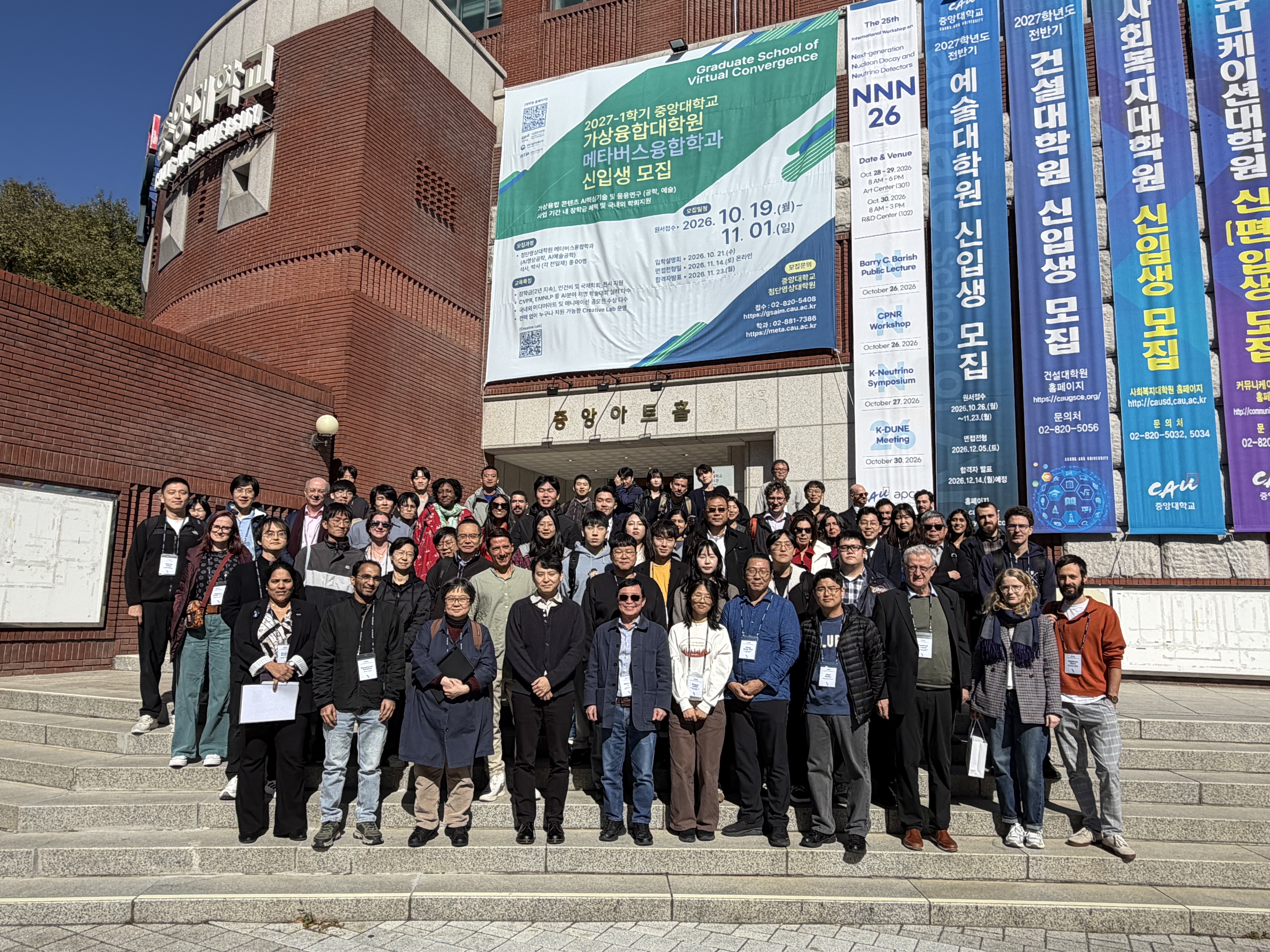
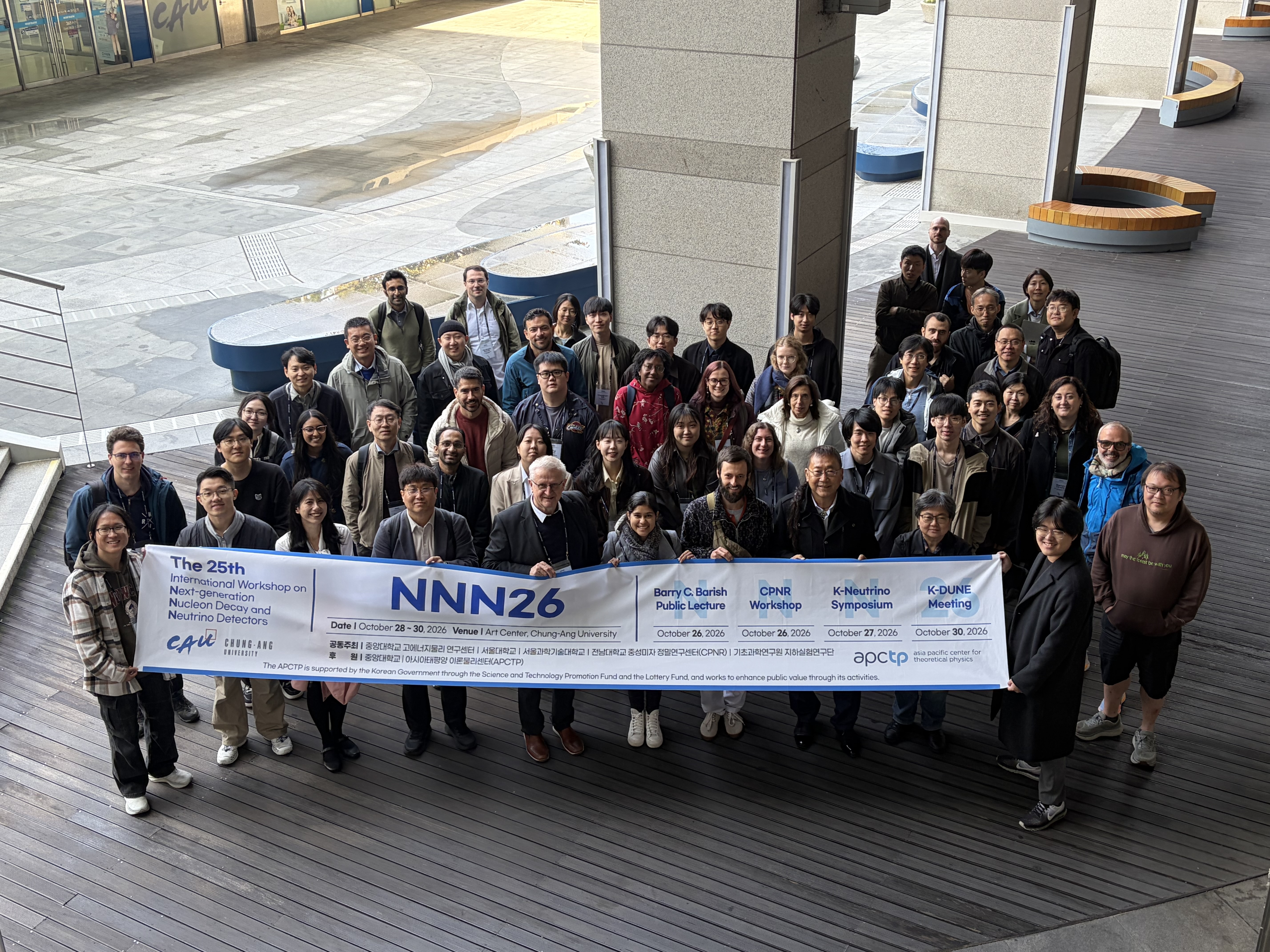
The NNN26 Workshop will be held at Chung-Ang University in Seoul, South Korea, from October 28 to 30, 2026. The workshop focuses on the expanding impact of neutrino physics across particle physics, astrophysics, cosmology, nuclear physics, and related disciplines, while exploring future scientific opportunities and experimental directions. NNN26 will place particular emphasis on emerging neutrino detector technologies and the detection frontier for next-generation experiments, together with the growing role of artificial intelligence and machine learning in experimental particle physics.
Co-hosts
- Chung-Ang University, High Energy Physics Center (CAU HEP Center)
- Chonnam National University, Center for Precision Neutrino Research (CNU CPNR)
- Institute for Basic Science, Center for Underground Physics (IBS CUP)
- Seoul National University (SNU)
- Seoul National University of Science and Technology (SeoulTech)
Sponsors
- Chung-Ang University
- Asia Pacific Center for Theoretical Physics (APCTP)
The APCTP is supported by the Korean Government through the Science and Technology Promotion Fund and the Lottery Fund, and works to enhance public value through its activities.
-
-
9:00 AM
→
5:00 PM
K-Neutrino&CPNR workshop CAU Art Hall
CAU Art Hall
Art Center, Chung-Ang University
84 Heukseok-ro, Dongjak District, Seoul -
5:30 PM
→
7:30 PM
Public Lecture Auditorium (CAU R&D Center)
Auditorium
CAU R&D Center
-
9:00 AM
→
5:00 PM
-
-
9:00 AM
→
5:00 PM
K-Neutrino&CPNR workshop CAU Art Hall
CAU Art Hall
Art Center, Chung-Ang University
84 Heukseok-ro, Dongjak District, Seoul -
5:00 PM
→
7:00 PM
Reception and Registration Exhibition Hall
Exhibition Hall
-
9:00 AM
→
5:00 PM
-
-
8:00 AM
→
8:40 AM
Opening Session: Welcome CAU Art Hall
CAU Art Hall
Art Center, Chung-Ang University
84 Heukseok-ro, Dongjak District, Seoul- 8:00 AM
-
8:10 AM
Welcome from CAU vice president 10mSpeaker: Jung Hyeok Koh
-
8:20 AM
NNN26, Opening Remark 20mSpeaker: Chang Kee Jung
-
8:40 AM
→
9:40 AM
Plenary Session: A CAU Art Hall
CAU Art Hall
Art Center, Chung-Ang University
84 Heukseok-ro, Dongjak District, SeoulConvener: Prof. Sin Kyu Kang (Seoul National University of Science and Technology)-
8:40 AM
Neutrino Phenomenology: Progress and Open Questions 30mSpeaker: Mariam Tortola
-
9:10 AM
Status & future prospects of long-baseline experiments 30mSpeaker: Chris Marshall (University of Rochester)
-
8:40 AM
-
9:40 AM
→
10:10 AM
Break 30m CAU Art Hall
CAU Art Hall
Art Center, Chung-Ang University
84 Heukseok-ro, Dongjak District, Seoul -
10:10 AM
→
11:30 AM
Plenary Session: B CAU Art Hall
CAU Art Hall
Art Center, Chung-Ang University
84 Heukseok-ro, Dongjak District, SeoulConvener: Yoomin Oh-
10:10 AM
Experimental status and prospects in neutrinoless double beta decay 30m
Neutrinoless double beta decay offers the most sensitive laboratory access to lepton number violation and to the Majorana nature of the neutrino, and the reach of any search is set directly by detector performance. I will review where the field stands: the leading experiments have set half-life limits above 10^26 yr in 136Xe and 76Ge, while the 130Te and 100Mo programs are now moving to their next-generation detectors. These results have established a great deal about energy resolution, background control, and the operation of detectors at the tonne scale. The next generation, aiming at sensitivities that reach 10^28 yr, approaches the same goal through very different detector strategies: high-purity germanium in LEGEND-1000, loaded liquid scintillator in KamLAND2-Zen, xenon time projection chambers in nEXO and high-pressure gas experiments, and cryogenic calorimeters in CUPID and AMoRE-II. The last two use the same isotope, 100Mo, but different readout technologies — germanium light detectors in CUPID, metallic magnetic calorimeters in AMoRE-II at Yemilab in Korea. I will close on what would be required to establish a discovery.
Speaker: Eunju Jeon (Institute for Basic Science) -
10:40 AM
Results and outlook of the LEGEND experimental program 20m
The LEGEND collaboration is searching for neutrinoless double-beta decay
($0\nu\beta\beta$) of $^{76}$Ge in the first phase of its experimental
program, LEGEND-200. Building on key technological innovations from its
predecessor high-purity germanium experiments, GERDA and the MAJORANA
DEMONSTRATOR, LEGEND aims to realize the tonne-scale LEGEND-1000
experiment, with a discovery sensitivity to $0\nu\beta\beta$ half-lives
beyond $10^{28}$ years. In this talk, an overview of the LEGEND
experimental program will be presented, along with the $0\nu\beta\beta$
limit from the combined analysis of the final GERDA and MAJORANA
DEMONSTRATOR data sets and the first LEGEND-200 data. Emphasis will be
placed on the latest LEGEND-200 background results following the recent
maintenance and reconfiguration of the detector array. These results
provide a key assessment of the experiment's performance and offer
important experimental input for the design and projected sensitivity
of LEGEND-1000.Speaker: David Hervas Aguilar (TUM) -
11:00 AM
NuDoubt++: Search for Double Beta Plus Decays 20m
Double beta plus decay modes (𝛽+𝛽+, 𝛽+𝐸𝐶, and 2𝐸𝐶) are rare second-order weak processes converting two protons into two neutrons. Their observation is difficult due to extremely low probabilities, complex signatures, and the low natural abundance of suitable isotopes.
Studying these decays offers insights into nuclear structure and fundamental symmetries. Decay rates depend on nuclear matrix elements (NMEs) and phase space factors (PSFs), crucial for interpreting data and refining theoretical models.
We introduce NuDoubt++, a novel detector concept for double beta plus decay searches with unprecedented sensitivity. It integrates hybrid and opaque scintillation technologies with advanced light readout to enhance positron detection.
Preliminary sensitivity estimates indicate that a 1-tonne-week exposure could probe the parameter space relevant for 2𝜈𝛽+𝛽+ and 2𝜈𝛽+𝐸𝐶 decays in the candidate isotope ⁷⁸Kr, while offering the potential to explore 0𝜈𝛽+𝛽+ decay with sensitivities well beyond current experimental limits.Speaker: Veronika Palusova -
11:20 AM
Campus Orientation, Photo 10m
-
10:10 AM
-
11:30 AM
→
12:30 PM
Lunch, your own free style 1h
-
12:30 PM
→
1:55 PM
Poster Session: Q Exhibition Hall
Exhibition Hall
-
2:00 PM
→
3:40 PM
Plenary Session: C CAU Art Hall
CAU Art Hall
Art Center, Chung-Ang University
84 Heukseok-ro, Dongjak District, SeoulConvener: Jianming Bian- 2:00 PM
-
2:30 PM
Short-Baseline Neutrino Experiments with Beams: Status and Prospects 30m
Abstract: Short-baseline accelerator neutrino experiments sit at the intersection of several open questions in neutrino physics. Persistent anomalies at L/E ~ 1 m/MeV, most notably the LSND and MiniBooNE electron-flavor excesses, have motivated a dedicated experimental program to test the existence of light sterile neutrinos, while the same detectors provide high-statistics measurements of neutrino–argon interactions, sensitive searches for physics beyond the Standard Model, and a proving ground for liquid argon time projection chamber technology on the path to DUNE. This talk will review the current status of beam-based short-baseline experiments, including the Fermilab Short-Baseline Neutrino program (MicroBooNE, SBND, and ICARUS) and JSNS² at J-PARC. Highlights include MicroBooNE’s search for 3+1 sterile neutrino oscillations using two neutrino beams, as well as recent progress from SBND, ICARUS, and JSNS². Prospects for the coming years and the program’s role in preparing for the next generation of long-baseline experiments will also be discussed.
Speaker: Jay Hyun Jo -
3:00 PM
SBND: Precision Neutrino Physics and Beyond 20m
The Short-Baseline Near Detector (SBND) is one of three liquid argon time projection chamber (LArTPC) neutrino detectors positioned along the axis of the Booster Neutrino Beam (BNB) at Fermilab, and serves as the near detector in the Short-Baseline Neutrino (SBN) Program. The detector just completed its second year of running, collecting over 6.5e20 POT, equivalent to an unprecedented sample of over 5 million neutrino interactions. Initial data has demonstrated superb performance of the detector’s subsystems, enabling precise tracking and calorimetric reconstruction of events. With this large statistical data set, SBND is performing multi-dimensional cross section measurements of inclusive and exclusive topologies and precise searches for beyond the Standard Model (BSM) processes. As the near detector in the SBN Program, it will enable the full potential of the joint sterile neutrino measurements program by precisely characterizing the unoscillated neutrino beam, constraining BNB flux and neutrino-argon cross-section systematic uncertainties.
In this talk, the current status of the experiment, first results from SBND’s neutrino interaction program, as well as status and prospects for BSM and oscillation searches are discussed.Speakers: Ornella Palamara (Fermilab), Ornella Palamara (Fermilab) -
3:20 PM
Status and latest results of the CONUS+ experiment 20m
After the first detection of coherent elastic neutrino-nucleus scattering (CEνNS) using reactor antineutrinos in the fully coherent regime in 2025, the CONUS+ experiment continued its measurements. Between the just mentioned Run-1 data and the latest Run-2 measurement, three of the four 1 kg germanium detectors were upgraded to 2.4 kg of active volume, which provide similar or even better noise performance. This results in a significant improvement in sensitivity, not only to the CEνNS cross section but also to the weak mixing angle sin²ϴ at low momentum transfer, probing the electroweak sector in a regime complementary to collider experiments.
This talk gives an overview of the measurement runs performed, focusing on the detector performance, analysis strategy, and latest physics results from the most recent campaign.Speaker: Matthias Meier
-
3:40 PM
→
4:10 PM
Break 30m CAU Art Hall
CAU Art Hall
Art Center, Chung-Ang University
84 Heukseok-ro, Dongjak District, Seoul -
4:10 PM
→
6:10 PM
Plenary Session: D CAU Art Hall
CAU Art Hall
Art Center, Chung-Ang University
84 Heukseok-ro, Dongjak District, SeoulConvener: Chang Hyon Ha (Chung-Ang University)-
4:10 PM
TBA ( Overview: Neutrinos in Cosmoloty and Large-scale structure survey) 30mSpeaker: Graziano Rossi
-
4:40 PM
The Detection of Astrophysical Neutrinos: Current Status and Future Prospects 30m
High-energy neutrinos provide a unique window into the most extreme environments in the Universe, carrying information from otherwise inaccessible regions and offering a complementary view to electromagnetic and gravitational-wave observations. Since the discovery of the diffuse flux of high-energy astrophysical neutrinos by the IceCube Neutrino Observatory, IceCube and other large-scale water Cherenkov detectors have been searching for the sources responsible for this flux. In this talk, I will review the major scientific achievements of IceCube and other leading experiments, and discuss the next steps toward identifying the sources of high-energy astrophysical neutrinos.
Speaker: Riya Shah (Kavli IPMU - UTokyo) -
5:10 PM
The IceCube Upgrade: Projections and Status 20m
The IceCube Neutrino Observatory is the largest Cherenkov neutrino telescope in operation. Located deep in the Antarctic ice sheet at the South Pole, IceCube has been operating in its full configuration for over 15 years. With its low-energy extension, DeepCore, the detector has produced precision measurements of neutrino oscillations and stringent limits on new physics. During the last Pole season, the detector was upgraded with the installation of additional strings hosting novel optical modules and a suite of calibration devices. In this talk, I will discuss the latest results from DeepCore, projections for the impact of the Upgrade on selected analyses, and an early look at data from the upgraded detector.
Speakers: Juan Pablo Yanez, Juan Pablo Yanez (University of Alberta) -
5:30 PM
The Pacific Ocean Neutrino Experiment 20m
The discovery of a diffuse astrophysical neutrino flux by IceCube in 2013 marked the beginning of the TeV-PeV neutrino astronomy era. This was followed by reports of evidence for neutrino emission from two active galaxies (TXS 0506+056 and NGC 1068), as well as an excess of neutrinos from the galactic plane of the Milky Way. However, the source classes responsible for extragalactic neutrinos remain unknown. Furthermore, the galactic flux originates from a combination of individual sources and a diffuse flux resulting from cosmic-ray propagation, but the exact proportions are unclear. Therefore, a new high-precision experiment is necessary to advance neutrino astronomy from the discovery era to an era of precision measurements.
The Pacific Ocean Neutrino Experiment (P-ONE) is a kilometre-scale, water-based Cherenkov neutrino telescope which is currently under construction in the Cascadia Basin, off the west coast of Canada. The experiment is designed to deliver excellent angular resolution for neutrino source searches, perform flavour-sensitive measurements of the diffuse astrophysical neutrino flux, and provide complementary marine science observations. The first detector string, P-ONE-1, reached several significant milestones in 2026, from the complete integration of the detector line to pre-deployment testing. It is due to be deployed at the experimental site in September 2026.
This talk will provide an overview of the current status and prospects of the experiment, including the construction, commissioning and operational plan of P-ONE-1. It will conclude with an outlook on the scientific potential of P-ONE for high-energy neutrino source searches.
Speaker: Woosik Kang (Drexel University) -
5:50 PM
TAMBO: Latest Status and Future Prospects 20m
The detection of astrophysical PeV neutrinos by current neutrino observatories has established neutrino astronomy as a powerful tool for exploring the high-energy universe. However, the identification of astrophysical sources remains challenging due to the large background from atmospheric neutrinos. The Tau Air-Shower Mountain-Based Observatory (TAMBO) is a next-generation experiment designed to address this challenge by detecting Earth-skimming tau neutrinos in the 1–100 PeV energy range, where backgrounds are strongly suppressed. The observatory will be deployed on the steep slopes of the Colca Valley in Peru, where tau neutrinos interacting within the surrounding mountains produce tau leptons that decay in the atmosphere, generating extensive air showers detected by an array of up to 5,000 scintillator stations.
This contribution presents the current status of the TAMBO project, with emphasis on its ongoing detector R&D program and the development of its prototype arrays. In particular, we report on the commissioning of TAMBO-4, a four-station scintillator array operating at the Pontificia Universidad Católica del Perú, which serves as a testbed for detector instrumentation, calibration, timing synchronization, data acquisition, and air-shower reconstruction. We summarize recent progress in detector construction, electronics development, calibration using cosmic-ray muons and radioactive sources, and detailed CORSIKA and GEANT4 simulations used to optimize detector performance and reconstruction techniques. We also discuss the next phase of the project, including the deployment of TAMBITO, a 100-station demonstrator in the Colca Valley, the projected timeline toward the full observatory, and the unique scientific opportunities that TAMBO will provide for multimessenger astrophysics, neutrino flavor studies, and searches for physics beyond the Standard Model.
Speaker: Prof. Jose Bazo (Pontificia Universidad Catolica del Peru)
-
4:10 PM
-
8:00 AM
→
8:40 AM
-
-
8:00 AM
→
9:30 AM
Plenary Session: F CAU Art Hall
CAU Art Hall
Art Center, Chung-Ang University
84 Heukseok-ro, Dongjak District, SeoulConvener: Guang Yang (Brookhaven Naitonal Laboratory)-
8:00 AM
The DUNE Near Detector: Design and Current Status 20m
The Deep Underground Neutrino Experiment (DUNE) is a next-generation long-baseline neutrino oscillation experiment designed to make measurements of neutrino oscillations with high precision and probe for new physics. Neutrinos will be measured at two detector facilities, namely a Near Detector (ND) located at Fermilab close to where the neutrino beam is produced by the Long-Baseline Neutrino Facility (LBNF), and a Far Detector located 1300 km away at the Sanford Underground Research Facility (SURF). The ND will play a crucial role in measuring the unoscillated neutrino flux, which is needed to constrain systematic uncertainties for precisely measuring neutrino oscillation parameters and determining the neutrino mass ordering. In this talk, the design of the ND facility and its detectors, their current status, and their related prototyping campaigns are presented.
Speaker: Erin Yandel (Los Alamos National Lab) -
8:20 AM
The DUNE Far Detector Module 3: Technology & Physics Prospects 20m
The Deep Underground Neutrino Experiment (DUNE), hosted by Fermi National Accelerator Laboratory and with its far detector located at the Sanford Underground Research Facility in South Dakota, represents the flagship next-generation long-baseline neutrino oscillation experiment. As part of DUNE Phase-II, the third far detector module (FD3) is a critical milestone in expanding the experiment's physics reach, providing additional fiducial mass toward the full target of more than 40 kt of liquid argon equivalent across four modules. FD3, in combination with the other far detector modules and the upgraded near detector, will enable full sensitivity to CP violation and world-leading precision on key oscillation parameters.
FD3 builds upon the Vertical Drift Liquid Argon Time Projection Chamber technology successfully validated through the ProtoDUNE programme at CERN. Its reference design retains the central cathode and dual-anode vertical drift architecture, with targeted upgrades to both the charge readout planes (CRPs) and the photon detection system. The collaboration is actively exploring the possibility of pixellated CRPs, which would provide true three-dimensional hit reconstruction without ambiguity, as an alternative or complementary approach. On the photon detection side, the FD3 reference design includes the APEX concept, integrating large-area photon detectors directly into the field cage structure, providing substantially improved photon coverage and enabling a low energy threshold for analysis.
This talk will present the ongoing R&D program for FD3, including activities at CERN's Neutrino Platform, and the projected physics impact of FD3 within the broader DUNE science program.
Speaker: Anyssa Navrer-Agasson -
8:40 AM
Development and Characterization of the Photon Detection System for DUNE Experiment 20m
DUNE is an international long baseline neutrino experiment and will be the largest of its kind. It will determine the neutrino mass ordering, search for CP violation in the lepton sector, and perform precision tests of the neutrino oscillation paradigm. DUNE will use an intense muon neutrino beam produced, together with a Near Detector located on the Fermilab site and a Far Detector installed 1,300 km away at the Sanford Underground Research Facility.
The DUNE Far Detector will employ liquid argon time projection chamber (LArTPC) technology for charge readout and a Photon Detection System (PDS) based on X-ARAPUCA technology to detect the 128 nm scintillation light produced in liquid argon. PDS is a key component of the DUNE, providing precise timing information and scintillation light measurements for event reconstruction, triggering, and low energy physics. This contribution will present the design and implementation of the X-ARAPUCA PDS for the DUNE Far Detector module. The operating principles, detector characterization, and performance validation will be discussed with respect to the general and physical requirements of DUNE.Speaker: Maritza J. Delgado Gonzalez (INFN Milano Bicocca) -
9:00 AM
Fundamental Neutrino Science at Chooz — CLOUD experiment and Beyond. 30m
The Double Chooz experiment delivered some of the most precise reactor-antineutrino measurements to date. With its legacy established and backgrounds well characterised, the Chooz underground site — powered by two N4-generation PWR cores — remains one of Europe’s most compelling facilities for reactor-antineutrino physics. Two new programmes are now charting the site’s next chapter (3rd generation), both built on the LiquidO detection paradigm — the deliberate exploitation of opaque scintillating media for event-by-event topology imaging.
The first is CLOUD experiment, a reactor-sited funded and developed as byproduct of the AntiMatterOTech programme (EIC “Pathfinder”) currently under construction, through a sequence of three experimental stages. CLOUD will deploy the LiquidO technology at the neutrino-physics scale for the first time, validating event-topology imaging, positron tagging and the heavy-target loading capabilities unique to opaque scintillators. Located in the so-called Ultra-Near-Detector position, at ~35 m from the reactor core, the experiment is expected to collect tens of thousands of antineutrinos per day. While designed as a technological demonstrator, CLOUD carries its own scientific agenda: addressing open questions with reactor-antineutrinos and exploring novel detection channels; including special sensitivity to spent-fuel antineutrinos relevant to nuclear safeguards.
The second is SuperChooz, a substantially larger LiquidO detector currently under exploration. SuperChooz inherits and scales up the techniques proven by CLOUD, with a twin scientific mission. On the reactor side, it aims to measure θ13 to per-mille precision — an order of magnitude beyond the current world average. Simultaneously, SuperChooz targets real-time solar-neutrino astrophysics, including, for the first time, spectroscopy of the pp neutrinos (directly sensitive to vacuum θ12) via charged-current interactions on indium-loaded opaque scintillator — a detection channel that LiquidO’s heavy loading is uniquely suited to enable. The combination of reactor and solar measurements in a single detector opens a new window for precision oscillation physics and multi-messenger probes of the solar interior.
I will present the physics case, the detector concept and the status of both programmes, with the main focus on CLOUD.
Speaker: Anatael Cabrera (CNRS / Université Paris-Saclay)
-
8:00 AM
-
9:30 AM
→
10:00 AM
Break 30m CAU Art Hall
CAU Art Hall
Art Center, Chung-Ang University
84 Heukseok-ro, Dongjak District, Seoul -
10:00 AM
→
11:30 AM
Plenary Session: G CAU Art Hall
CAU Art Hall
Art Center, Chung-Ang University
84 Heukseok-ro, Dongjak District, SeoulConvener: Eunju Jeon (Institute for Basic Science)-
10:00 AM
Enabling Hyper-Kamiokande: Detector Technologies for the Next Generation of Neutrino Physics 20m
Hyper-Kamiokande is the next-generation large-scale water Cherenkov neutrino experiment, currently under construction in Japan. Its ambitious physics programme, including precision measurements of neutrino oscillations, searches for nucleon decay, and observations of neutrinos from astrophysical sources, places demanding requirements on detector performance and instrumentation.
This presentation will focus on the detector technologies that enable the broad physics programme of Hyper-Kamiokande. Its different physics goals impose requirements on photon detection efficiency, timing and spatial resolution, event reconstruction, energy resolution, background rejection, and detector mass. We will explore how these requirements are addressed through the design and technologies employed in Hyper-Kamiokande, with particular emphasis on the photosensors and other key detector systems. The principles and performance of these technologies will be discussed in relation to the physics they enable, highlighting the design considerations and trade-offs involved in building a detector capable of addressing such a broad range of physics.
Speaker: Robert Kralik (King's College London) -
10:20 AM
Exploring Physics with Liquid Scintillator Detectors 20mSpeaker: Minfang Yeh
-
10:40 AM
Results, Status, and Prospects of SK-Gd 20m
The Super-Kamiokande (SK) experiment is a world-leading, 50-kton water Cherenkov detector in Japan. Gadolinium sulfate has been loaded into the tank at 0.01% and 0.03% by mass in 2020 and 2022, respectively, to start the SK-Gd era and significantly improve the identification of neutron captures. Here, we discuss the status of SK-Gd, its latest results, and some prospects for the future. Topics covered include new analyses of solar neutrinos, the observation of reactor anti-neutrinos, updates on oscillation parameters from atmospheric neutrinos, supernova monitoring, and the hunt for the Diffuse Supernova Neutrino Background.
Speaker: Andrew Santos (Kavli IPMU - UTokyo) -
11:00 AM
Expected performance of a water Cherenkov detector for reactor antineutrino--electron scattering at the RENO near-detector site 15m
We evaluate the expected performance of a water Cherenkov detector for reactor antineutrino--electron elastic scattering at the RENO near-detector site. The reactor-spectrum normalization is extracted from the reconstructed recoil-electron directional distribution using a constrained profile-likelihood analysis, while the effects of different event-selection thresholds and relevant background components, including PMT radioactivity and residual inverse-beta-decay events, are taken into account. Our results show that the characteristic directional correlation of elastic-scattering events provides effective discrimination between the reactor antineutrino signal and largely isotropic backgrounds. These results demonstrate that directional information in a water Cherenkov detector can enable percent-level sensitivity to the reactor antineutrino elastic-scattering normalization and highlight the potential of this approach for precision reactor-neutrino measurements.
Speaker: Sunhong Kim -
11:15 AM
Modulated neutrino signals in a wave dark matter background 15m
Fundamental properties of neutrinos need not remain constant, but may become dynamical through a non-standard interaction with the dark sector. An oscillating wave dark matter can induce periodic variations in neutrino mass or transitions between Dirac and Majorana types. The resulting dynamics can modulate rare neutrino processes, including neutrinoless double beta decay and cosmic neutrino background. These modulations provide distinctive time-dependent signatures for experimental searches. We also generalized this framework to a mixed wave dark matter scenario that produces non-harmonic behavior with multiple frequencies. This talk is based on our recent papers PRD 108, 095028 (2023); JHEP 07 (2025) 269; arXiv: 2604.14480.
Speaker: Yechan Kim (KAIST)
-
10:00 AM
-
11:30 AM
→
12:30 PM
Lunch, your own free style 1h
-
12:30 PM
→
1:55 PM
Poster Session: R Exhibition Hall
Exhibition Hall
-
2:00 PM
→
3:10 PM
Plenary Session: H CAU Art Hall
CAU Art Hall
Art Center, Chung-Ang University
84 Heukseok-ro, Dongjak District, SeoulConvener: Myeonghun Park-
2:00 PM
Towards a Fast and Precise Pipeline for Neutrino Event Reconstruction in Hyper-Kamiokande 20m
Hyper-Kamiokande (HK) is the next generation of water Cherenkov detector in Japan,currently under construction and scheduled to begin data-taking in 2028. With a fiducial volume about 8 times larger than Super-Kamiokande's (SK), HK will record an unprecedented number of neutrino interactions, enabling precise measurements of neutrino oscillation parameters, searches for CP violation in the lepton sector, and searches for nucleon decay. This increased event rate brings two major challenges for event reconstruction in HK: processing the large volume of data with sufficient speed, and improving reconstruction performance to reduce systematic uncertainties which will otherwise become a limiting factor for several key measurements.
The reconstruction efforts pursued in HK address both challenges through complementary approaches. The baseline reconstruction, inherited from SK’s likelihood algorithms such as fiTQun, will provide a robust starting point for seamless day-one physics analyses. Several developments aim to improve the processing time and performances of this likelihood-based approach. In parallel, machine-learning models are being actively developed as a complementary reconstruction pipeline, and have already demonstrated improved performance for single-ring reconstruction, in some cases matching or surpassing the likelihood methods. This ML pipeline is now being extended towards multi-ring reconstruction, while its robustness against detector systematics is being investigated.
In this talk, I will present the status of the aforementioned efforts towards an improved reconstruction pipeline for the start of HK data-taking. In particular, I will report on the neutrino event reconstruction speed and resolution performances for the different likelihood and ML approaches.
Speaker: Lorenzo Perisse (ILANCE (CNRS - UTokyo)) -
2:20 PM
AI -driven Reconstruction Pipelines in Neutrino Experiments 20mSpeaker: Jianming Bian
-
2:40 PM
Representation Learning of Detector Data for Novel Physics Inference 30m
Deep learning, particularly techniques adapted from modern computer vision, has substantially advanced the analysis capabilities of particle and nuclear physics experiments, neutrino experiments in particular. Most of these applications, however, rely on supervised learning: the model is trained on simulated events with known labels, and therefore inherits the assumptions and imperfections of the simulation. Self-supervised learning (SSL) is an emerging alternative that learns directly from data without labels, and can therefore also capture features of real data that are not yet modeled in simulation. A successfully trained SSL model provides an encoder that converts each event into a compact, general-purpose numerical summary (a "representation") that can serve many, ideally all, tasks on the same dataset. Because of this generality, such a model is called a foundation model.
If the representations capture the information in the data in a simple form, downstream tasks, such as particle type identification, kinematics regression, panoptic segmentation (grouping pixels into individual particles and interactions), and parentage reconstruction (determining which particle produced which), can each be solved by a small model trained on a small dataset. Representations also open the door to new inference techniques. For example, comparing representations of data and simulation can quantify and help reduce their mismatch; in an oscillation experiment, comparing near- and far-detector representations can quantify distributional shifts; and clustering events in representation space may reveal new physics or anomalous detector behavior.
Despite this potential, applying SSL to particle detector data is challenging because of the nature and scale of the data. The data are globally sparse but locally dense: fewer than 1% of pixels are non-zero, yet signals are densely sampled where present. The data are also large: each event is recorded as multiple 2D projections or a single 3D image containing 100,000 to 1,000,000 non-zero pixels. Together, these properties yield very low information density per pixel, unlike the natural images for which SSL methods were developed.
In this talk, I will present the status of sensor-level foundation models, i.e., SSL applied directly to sensor-level detector data. Recent results demonstrate that a single model architecture and training method can be applied effectively across multiple detector technologies, including liquid argon (DUNE, SBN) and high-pressure gaseous xenon (NEXT) time projection chambers (TPCs), water Cherenkov detectors, and the sPHENIX silicon tracker (using its open dataset). Building on this progress toward mastering SSL for high energy and nuclear physics experiments, I will briefly discuss next steps in AI R&D and the development of new physics inference methods that exploit learned representations.
Speaker: Kazuhiro Terao
-
2:00 PM
-
3:10 PM
→
3:40 PM
Break 30m CAU Art Hall
CAU Art Hall
Art Center, Chung-Ang University
84 Heukseok-ro, Dongjak District, Seoul -
3:40 PM
→
4:35 PM
Plenary Session: I CAU Art Hall
CAU Art Hall
Art Center, Chung-Ang University
84 Heukseok-ro, Dongjak District, SeoulConvener: Mariam Tortola-
3:40 PM
Changing the Culture of Science, Together 15mSpeaker: Jeong In Yun
-
3:55 PM
Constraining Supernova Dynamics with SN1987A Neutrinos 20m
The neutrino signal from SN1987A offers a unique opportunity to study the
dynamics of core-collapse supernovae, but its interpretation has been hindered
by detector timing uncertainties and ambiguities in the origin of the earliest
events. I will present a new statistical analysis combining neutrino energies,
arrival times, and angular distributions within a realistic parametric emission
model including an initial accretion phase and subsequent cooling evolution.
The analysis confirms the existence of an accretion phase at the 99% con-
fidence level and determines the thermodynamical properties and time-scale of
the emission.
By introducing a systematic treatment of detector timing offsets, we recon-
struct the SN1987A neutrino timeline with sub-second precision, overcoming
historical uncertainties of Kamiokanke-II and Baksan’s clocks. This allows a
quantitative test of the nature of the first Kamiokande-II event, showing a sta-
tistical preference for an accretion-phase electron antineutrino origin over the
neutronization burst case.
The resulting framework provides the most precise reconstruction of the
SN1987A neutrino emission timeline to date and offers a methodology directly
applicable to future Galactic supernova neutrino observations.Speaker: Giulia Ricciardi (Dipartimento di Fisica E. Pancini, Universita' di Napoli Federico II) -
4:15 PM
Constraining neutrino interaction at the Electron-Ion Collider 20m
Next-generation neutrino oscillation experiments such as the Deep Underground Neutrino Experiment require percent-level knowledge of neutrino-nucleon interaction cross sections. The Electron-Ion Collider and future nuclear collider has the capability of selecting certain spin and isospin state with controlled incident particle energy. Given that, there are a few ways to constrain a few key interaction parameters at the nuclear colliders such as EIC, including things such as form factor and the 2p2h strength. In this talk, I can go through a few possibilities and discuss the potential of utilizing the next-generation nuclear detector data to constrain the neutrino interaction modeling.
Speaker: Guang Yang (Brookhaven National Laboratory)
-
3:40 PM
-
4:50 PM
→
5:25 PM
Dinner - The bus departs at 5 pm in front of building 201 35m CAU Art Hall
CAU Art Hall
Art Center, Chung-Ang University
84 Heukseok-ro, Dongjak District, Seoul -
6:00 PM
→
8:00 PM
Banquet at Sevit Island 2h Chatvit Cuisine
Chatvit Cuisine
-
8:00 AM
→
9:30 AM
-
-
8:00 AM
→
9:30 AM
Plenary Session: J Auditorium (Rm 314) (CAU R&D Center (Bldg 102))
Auditorium (Rm 314)
CAU R&D Center (Bldg 102)
Convener: Chris Marshall (University of Rochester)-
8:00 AM
Latest physics results from JUNO 30m Auditorium (Rm 314) (R&D Center (Bldg 102))
Auditorium (Rm 314)
R&D Center (Bldg 102)
The Jiangmen Underground Neutrino Observatory (JUNO) is a 20‑kt liquid‑scintillator detector operating at a baseline of ~53 km from two nuclear reactor complexes in southern China. Its primary goal is to determine the neutrino mass ordering via reactor antineutrinos, exploiting excellent energy resolution and low background.
Since detector commissioning in 2025, JUNO has been taking stable data. JUNO has delivered several key results: a precision measurement of the reactor antineutrino spectrum, yielding the most precise determination of |Δm₃₁²| from reactor experiments; a 2.3σ preference for the Normal Mass Ordering when combined with external constraints; and the first geo‑neutrino measurement from JUNO, giving a flux of 73 ± 11 TNU.
The future program extends well beyond mass ordering. JUNO will continue to improve solar neutrino oscillation parameters, provide real‑time supernova alerts, and search for rare processes. In particular, the large target mass and ultra‑low backgrounds make JUNO a promising platform for neutrinoless double‑beta decay (0νββ) searches through isotope loading (¹³⁶Xe or ¹³⁰Te) in the liquid scintillator. These efforts, together with atmospheric and astrophysical neutrino studies, will establish JUNO as a multi‑purpose facility for neutrino physics over the next decade.
This talk will present the design, current operational status, recent physics results, and prospective upgrade plans of the JUNO experiment.
Speaker: Cong Guo -
8:30 AM
The Deep Underground Neutrino Experiment (DUNE) 30m Auditorium (Rm 314)
Auditorium (Rm 314)
CAU R&D Center (Bldg 102)
DUNE is a next-generation long-baseline neutrino oscillation experiment and underground neutrino observatory using liquid argon time projection chamber technology. DUNE will measure neutrino and antineutrino oscillations as a function of energy over more than a full oscillation period. It will definitively resolve the neutrino mass ordering and measure the mixing matrix parameters, including the CP-violating phase, as well as search for deviations from three-flavour mixing. DUNE is also sensitive to MeV-scale neutrinos, with unique sensitivity to electron neutrinos from the neutronization burst of a supernova, and complementary to other experiments that are predominantly sensitive to electron antineutrinos. DUNE has broad sensitivity to new physics, both from production in the beamline as well as in the cosmos. The excavation project of the far detector site at SURF is complete, and DUNE is on schedule for first physics results in this decade.
This talk will cover the status of DUNE, the exciting future science program, including updated sensitivities with the most recent schedule, and results from DUNE prototype detectors.Speaker: Rhiannon Smith-Jones (University of Sheffield) -
9:00 AM
Latest status and prospects of Hyper-Kamiokande 30m Auditorium (Rm 314)
Auditorium (Rm 314)
CAU R&D Center (Bldg 102)
Hyper-Kamiokande is the next generation Water Cherenkov experiment in Japan, following the highly successful Kamiokande and Super-Kamiokande experiments. It is currently under construction and will start taking data in 2028. The experiment is located in two sites separated by 295 km, with a massive 258 kilotonne water Cherenkov detector located in Kamioka town on one side, and a neutrino beamline with a set of detectors in the J-PARC center on the East coast of Japan. The experiment has a broad physics program, including the precise study of the oscillations of accelerator, atmospheric and solar neutrinos, searching for proton decay, the detection of supernova neutrinos. It will also conduct additional searches for physics beyond the standard model, such as indirect dark matter detection. The very large size of the Hyper-Kamiokande detector gives it the world’s best sensitivity to proton decay. Combined with the increased intensity of the neutrino beamline and a new “intermediate” detector in J-PARC, Hyper-Kamiokande also has world leading sensitivity to study the remaining open questions in neutrino oscillations, in particular whether neutrinos and antineutrinos oscillate in the same way or not (CP symmetry).
In this presentation, we will first present the experiment and its physics program, including the sensitivity of the experiment for the different topics. The construction of the experiment has achieved a number of significant milestones in the last couple of years, and we will present its status and the plans towards completion of the construction in the second part of the presentation.Speaker: Christophe Bronner (Yokohama National University)
-
8:00 AM
-
9:30 AM
→
9:50 AM
Break 20m CAU R&D Center (Bldg 102)
CAU R&D Center (Bldg 102)
-
9:50 AM
→
11:45 AM
Plenary Session: K Auditorium (Rm 314) (CAU R&D Center (Bldg 102))
Auditorium (Rm 314)
CAU R&D Center (Bldg 102)
Convener: Jay Hyun Jo-
9:50 AM
Forward Experiments at the LHC: Neutrino Studies and Future Prospects 30m
The Large Hadron Collider (LHC) produces the highest-energy accelerator
neutrinos, providing new opportunities to study neutrino interactions at
TeV energies. The FASER and SND@LHC experiments have successfully
detected neutrinos originating from LHC collisions and have begun
exploring this previously unmeasured energy regime with accelerator
neutrinos.In this talk, I will review recent results from both experiments,
including measurements of neutrino interactions, cross sections, and
fluxes. These measurements offer opportunities to probe new physics in
neutrino interactions, shed light on QCD and forward hadron production,
and provide crucial input to astroparticle physics.I will also discuss future prospects for forward neutrino physics at the
High-Luminosity LHC, including detector upgrades for LHC Run 4, the
proposed Forward Physics Facility, and other detector concepts.Speaker: Tomoko Ariga -
10:20 AM
CEvNS and MeV-scale Cross Section Measurements for Supernova Neutrinos 30m
Coherent elastic neutrino–nucleus scattering (CEvNS) is a neutral-current weak interaction in which a neutrino scatters coherently from an entire nucleus at low momentum transfer. The coherent enhancement of the nuclear weak charge yields a cross section that scales approximately as N^2, while the associated nuclear recoils are typically at the keV or sub-keV scale. The Standard-Model prediction is theoretically well constrained, subject to nuclear-form-factor and detector-response uncertainties, making CEvNS a sensitive probe of electroweak interactions and possible physics beyond the Standard Model.
This talk will review the experimental landscape of CEvNS, including measurements with neutrinos from stopped-pion decay and nuclear reactors, as well as the emerging sensitivity to solar-neutrino CEvNS in dark-matter detectors. The current experimental program and prospects for future CEvNS measurements will also be briefly discussed. Finally, the talk will consider how CEvNS and stopped-pion neutrino facilities can improve the interpretation of future supernova-neutrino observations through measurements of neutrino interaction cross sections at supernova-relevant energies.
Speaker: Yun-Tse Tsai -
10:50 AM
Workshop Summary 30mSpeaker: Manfred Lindner (Max-Planck-Institute für Kernphysik)
-
11:20 AM
Photo 15m
-
9:50 AM
-
11:40 AM
→
1:00 PM
Lunch together at University Club 1h 20m University Club (11Fl) (CAU R&D Center (Bldg 102))
University Club (11Fl)
CAU R&D Center (Bldg 102)
-
1:00 PM
→
3:00 PM
Closing Session: Closing Session (Plenary) Auditorium (Rm 314) (CAU R&D Center (Bldg 102))
Auditorium (Rm 314)
CAU R&D Center (Bldg 102)
-
1:00 PM
Summary of CPNR Workshop 15mSpeaker: Byeongsu Yang (Chonnam National University)
- 1:15 PM
-
1:30 PM
Summary of K-Neutrino 15mSpeaker: Chang Hyon Ha (Chung-Ang University)
-
1:45 PM
Poster Awards 15m
- 2:00 PM
-
2:15 PM
Closing 15m
-
1:00 PM
-
4:00 PM
→
7:40 PM
[Satellite]: K-DUNE Meeting Rm 106 (CAU R&D Center (Bldg 102))
Rm 106
CAU R&D Center (Bldg 102)
Convener: Kim Siyeon (Chung-Ang University)-
4:00 PM
[Satellite] DUNE Introduction and Q&A 40mSpeakers: David Newbold, Sowjanya Gollapinni
-
4:40 PM
[Satellite] K-DUNE Introduction 20mSpeaker: Kim Siyeon (Chung-Ang University)
-
5:00 PM
[Satelite] Past and Future Contribution to DUNE 55mSpeakers: Kim Siyeon, Myeonghun Park, Seodong Shin, Sungbin Oh, Young Ju Ko
-
6:10 PM
[Satellite] Proposals of New Contribution to DUNE 50m
-
7:00 PM
[Satellite] Round-Table discussion 30m
-
4:00 PM
-
8:00 AM
→
9:30 AM